| SNAP Data Processors - IdePix MERIS Processor Description | |
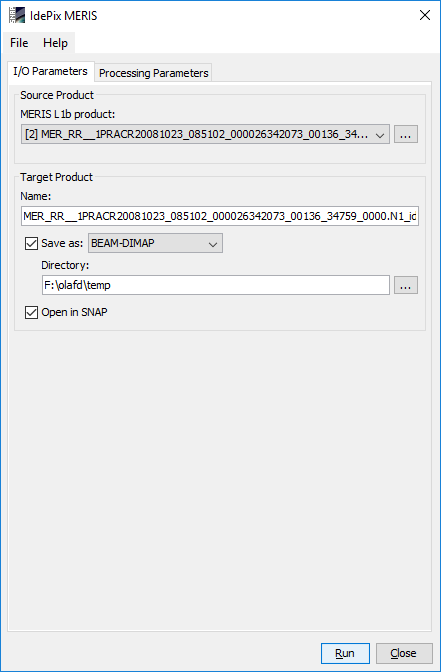
Name: Used to select the spectral source product. The source product shall contain spectral bands providing a source spectrum at each pixel. Use the ... button to open a data product currently not opened in the Sentinel Toolbox.
For detailed product descriptions and file naming conventions see MERIS Product Handbook (http://envisat.esa.int/handbooks/meris/CNTR.html).
For more detailed information on MERIS 4th reprocessing products, see the Release Notes (https://earth.esa.int/eogateway/news/release-of-envisat-meris-4th-reprocessing-data-new-online-dissemination-service) as starting point.
Name: Used to specify the name of the target product.
Save to: Used to specify whether the target product should be saved to the file system. The combo box presents a list of file formats.
Open in SNAP: Used to specify whether the target product should be opened in the Sentinel Toolbox. When the target product is not saved, it is opened in the Sentinel Toolbox automatically.
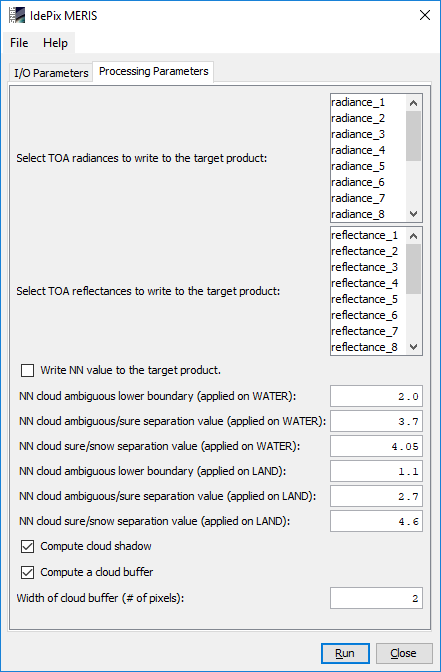
Select TOA radiances to write to the target
product:
The TOA radiance bands from the source product which shall be
written into the target product can be selected here. Multiple
selection is possible.
Select TOA reflectances to write to the target
product:
The intermediately computed TOA reflectances bands which shall be
written into the target product can be selected here. Multiple
selection is possible.
Write NN value to the target product:
If selected, the output value of the neural network (floating
point number on the interval [0.0, 5.0]) is written to the target
product. The default is 'false'.
NN cloud ambiguous lower boundary (applied on
WATER):
The boundary of the neural network output value where pixels are
regarded as either clear (NN output lower than boundary) or 'cloud
ambiguous' (NN output higher than boundary), in case of pixels
which have been classified as WATER. Providing the NN cloud
ambiguous lower boundary as user option allows a fine tuning of the
pixel classification under certain conditions. The default value is
2.0.
NN cloud ambiguous/sure separation value (applied
on WATER):
The boundary of the neural network output value where pixels are
regarded as either 'cloud ambiguous' (NN output lower than
boundary) or 'cloud sure' (NN output higher than boundary), in case
of pixels which have been classified as WATER. Providing the NN
cloud ambiguous/sure separation value as user option allows a fine
tuning of the pixel classification under certain conditions. The
default value is 3.7.
NN cloud sure/snow separation value (applied on
WATER):
The boundary of the neural network output value where pixels are
regarded as either 'cloud sure' (NN output lower than boundary) or
'snow' (NN output higher than boundary), in case of pixels which
have been classified as WATER. Providing the NN cloud sure / snow
separation value as user option allows a fine tuning of the pixel
classification under certain conditions. The default value is
4.05.
NN cloud ambiguous lower boundary (applied on
LAND):
The boundary of the neural network output value where pixels are
regarded as either clear (NN output lower than boundary) or 'cloud
ambiguous' (NN output higher than boundary), in case of pixels
which have been classified as LAND. Providing the NN cloud
ambiguous lower boundary as user option allows a fine tuning of the
pixel classification under certain conditions. The default value is
1.1.
NN cloud ambiguous/sure separation value (applied
on LAND):
The boundary of the neural network output value where pixels are
regarded as either 'cloud ambiguous' (NN output lower than
boundary) or 'cloud sure' (NN output higher than boundary), in case
of pixels which have been classified as LAND. Providing the NN
cloud ambiguous/sure separation value as user option allows a fine
tuning of the pixel classification under certain conditions. The
default value is 2.7.
NN cloud sure/snow separation value (applied on
LAND):
The boundary of the neural network output value where pixels are
regarded as either 'cloud sure' (NN output lower than boundary) or
'snow' (NN output higher than boundary), in case of pixels which
have been classified as LAND. Providing the NN cloud sure / snow
separation value as user option allows a fine tuning of the pixel
classification under certain conditions. The default value is
4.6.
Compute cloud shadow:
If set, a cloud shadow is computed and added to the pixel
classification. The default value is 'true'.
Compute a cloud buffer:
If set, a cloud buffer of certain width is computed and added to
the pixel classification. The default value is 'true'.
Width of cloud buffer (# of pixels):
If a cloud buffer is computed, the buffer width (in # of pixels
around the cloudy reference pixel) can be specified. The default
value is '2'.