Naive Bayes Classification
Naive Bayes is a probabilistic classifier based
on applying Bayes' theorem with the naïve assumption that
features are conditionally independent given the class. In the
Gaussian variant used for numeric features, each
feature is modeled by a class-conditional normal distribution.
Given a feature vector x = (x1, …,
xd) and class c, the proportional
form is:

where P(c) is the class prior, and
μc,j, σc,j are the per-class
mean and standard deviation for feature j.Prediction
chooses argmaxc P(c | x).
The fully normalized form is:

For numerical stability, computation is performed in
log-space:

The decision rule is:
class(x) = argmaxc P(C = c) * ∏i P(Xi = xi | C = c)
where P(C = c) is the prior probability of class
c (estimated from training data), and the likelihood
term P(Xi | C = c) for numeric features is
computed from the Gaussian probability density function.
Operator Overview
The Naive Bayes Classification operator integratesWEKA
weka.classifiers.bayes.NaiveBayes classifier into
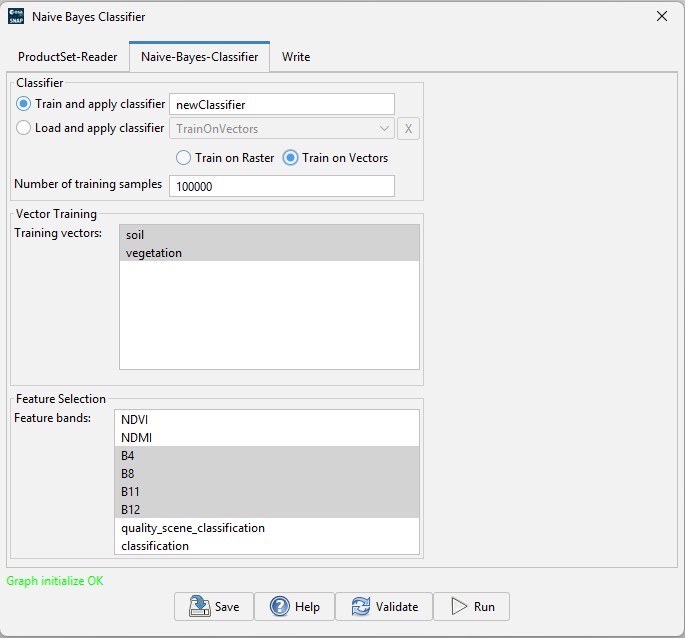
SNAP. It supports training from a label band/list of
vectors or loading a pre-trained model, and classifies per
pixel in a tile-based fashion.
- Training: from a label band / list of vectors
in the source product (supervised learning) or load a pre-trained
model bundle.
- Features: user-selected input bands.
- Outputs: class label band and confidence
band.
- Model management: models are saved/loaded
under SNAP's
auxdata/classification/NaiveBayes
directory with an associated parameter XML.
Note: When classifying optical products,
exclude clouds, shadows, water, or other unwanted areas using masks
to help maintain the validity of the Gaussian assumptions and
improve classification accuracy.
Note: For best results, use optical datasets
(e.g., Sentinel-2) with surface reflectance or brightness
temperature bands.
Inputs / Outputs
Source Products (sourceProducts) |
Any raster product (e.g., Sentinel-2 L1C/L2A) with numeric
bands. |
Target Product (targetProduct) |
Copy of the source geocoding and metadata; adds bands:
nb_class (for vector trained) or
predicted<trainingBand> (for raster trained)
(Int16): predicted class indexnb_confidence (Float32): posterior probability of
the predicted class in [0,1]
|
Parameters
| Name |
Type |
Description |
Default |
doLoadClassifier |
Boolean |
Choose to save or load classifier. If true, the operator will
load a previously trained and saved classifier. |
false |
savedClassifierName |
String |
The name of a previously trained and saved classifier.
Only used if doLoadClassifier is true. |
(empty) |
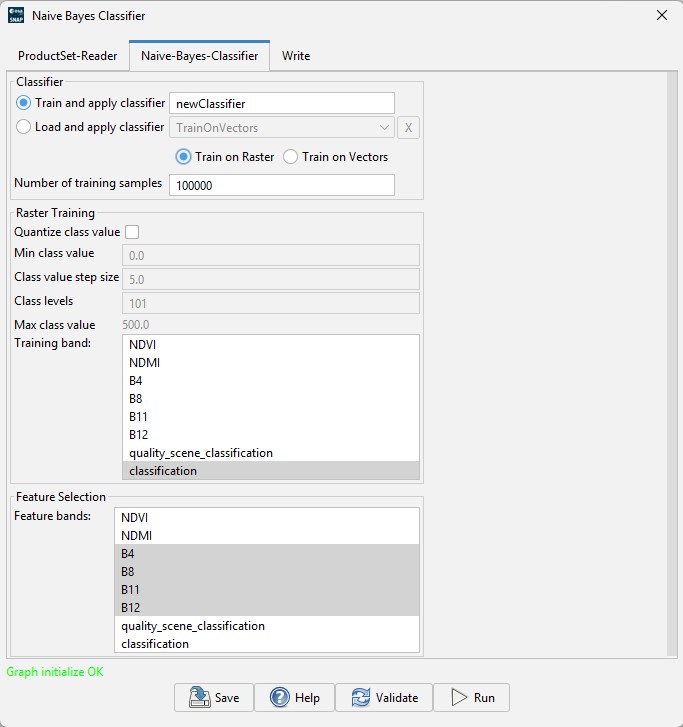
trainOnRaster |
Boolean |
Train on raster (true) or vector data
(false) |
false |
numTrainSamples |
Integer |
The number of training samples, interval (1,*] |
5000 |
trainingVectors |
String |
Name of the vectors that holds training labels.
The name of each vector is used as a class label and its position
as a class code (e.g. 1, 2...) .
Only specified if trainOnRaster=true.
At least 2 vectors are required. If not specified, all the vectors
of the first source product are used. |
(empty) |
trainingBands |
String |
Name of the band that holds training labels. Pixels with valid
(non-NaN) values are used as training samples.
Values are interpreted as integer class codes (e.g. 0, 1,
2...).
Only specified if trainOnRaster=false.
If not specified, the first band of the first source product is
used. |
(empty) |
doClassValQuantization |
Boolean |
Quantization for raster training. Ignored for vector
training. |
true |
minClassValue |
Double |
Quantization min class value for raster training. Ignored for
vector training or if
doClassValQuantization=false |
0.0 |
classValStepSize |
Double |
Quantization step size for raster training. Ignored for vector
training or if doClassValQuantization=false |
5.0 |
classLevels |
Double |
Quantization class levels for raster training. Ignored for
vector training or if
doClassValQuantization=false |
101 |
featureBands |
String array |
Names of bands used as features.
If not specified, all the bands of the first source product are
used. |
(empty) |
|
 |
Note: All input bands (features
and label) must have identical raster size. Pixels containing
NaN in any feature band are skipped for training and
assigned confidence = 0 during classification.
Trained model save / load
When a model is trained, the operator writes a bundled model
file under
~/.snap/auxdata/classification/NaiveBayes/:
<classifierName>.model - Java-serialized
bundle containing the classifier, the header-only dataset, and the
training instance count.<classifierName>.xml - associated XML with
selected parameters (classes, feature bands, training band,
etc.).
The saved models can be later used to classify other
products.
References
- [R-1] Aggarwal, C.C.. Data Classification: Algorithms and
Applications, CRC Press, 2014, Ch 3
- [R-2] Hastie, Tibshirani, Friedman. The Elements of
Statistical Learning, 2nd ed., Springer, 2009, Ch. 2 &
6.
- [R-3] Richards, Jia. Remote Sensing Digital Image
Analysis, Springer, 2006, Ch 8
- [R-4] https://scikit-learn.org/stable/modules/naive_bayes.html>
- [R-5] Weka 3 NaiveBayes Javadoc — University of
Waikato.
- [R-6] Weka Wiki — tutorials and usage examples.
- [R-7] Scikit-Learn — Naive Bayes documentation.
- [R-8] Scikit-Learn — Gaussian Naive Bayes
documentation.
- [R-9] Wikipedia — Naive Bayes classifier
