
| Thematic Land Processing | |
Radiometric indices are quantitative measures of features that are obtained by combining several spectral bands, features that are not otherwise obvious if using only one band.
The indices provided by the Optical Toolbox, detailed below, are grouped into three categories:
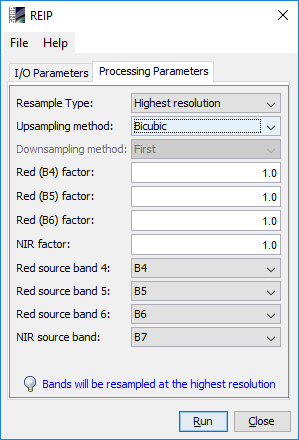
These indices share the same graphical interface, as in the next figure:
 |
|
In case of bands with different resolutions are employed, a
message is displayed at the bottom of the window, as it can be seen
on the above figure.
If no resample is needed, the parameters Resample Type,
Upsampling Method and Downsampling Method
will be disabled.
The parameters Upsampling Method and
Downsampling Method are mutually exclusive.
The following table summarizes the radiometric indices provided by the toolbox:
Name |
Purpose/Classification |
Short Description |
Type |
NDVI |
Normalized Difference Vegetation Index |
The well-known classical vegetation index. The NDVI composes a measurement for the photosynthetic activity and is strongly in correlation with density and vitality of the vegetation |
Vegetation Index |
DVI |
Difference Vegetation Index |
This index is sensitive to the amount of vegetation |
Vegetation Index |
RVI |
Ratio Vegetation Index |
The simplest ratio-based index, it is also called the Simple Ratio (SR). It indicates the amount of vegetation. It also reduces the effects of atmosphere and topography |
Vegetation Index |
PVI |
Perpendicular Vegetation Index |
This index could be considered a generalization of the DVI, which allows for soil lines of different slopes. |
Vegetation Index |
IPVI |
Infrared Percentage Vegetation Index |
This index is functionally equivalent to NDVI and RVI, but it only ranges in value from 0.0 - 1.0 |
Vegetation Index |
WDVI |
Weighted Difference Vegetation Index |
WDVI is a mathematically simpler version of PVI, but it has an unrestricted range |
Vegetation Index |
TNDVI |
Transformed Normalized Difference Vegetation Index |
TNDVI algorithm indicates a relation between the amount of green biomass that is found in a pixel |
Vegetation Index |
GNDVI |
Green Normalized Difference Vegetation Index |
GNDVI is more sensible than NDVI to identify different concentration rates of chlorophyll, which is highly correlated at nitrogen. |
Vegetation Index |
GEMI |
Global Environmental Monitoring Index |
Was developed to eliminate the need for a detailed atmospheric correction by constructing a stock atmospheric correction for the vegetation index |
Vegetation Index |
ARVI |
Atmospherically Resistant Vegetation Index |
This index takes advantage of the different scattering responses from the blue and red band to retrieve information regarding the atmosphere opacity |
Vegetation Index |
NDI45 |
Normalized Difference Index |
This index algorithm is more linear, with less saturation at higher values than the NDVI. |
Vegetation Index |
MTCI |
Meris Terrestrial Chlorophyll Index |
This index was developed for estimating chlorophyll content from MERIS (Medium Resolution Imaging Spectrometer) data |
Vegetation Index |
MCARI |
Modified Chlorophyll Absorption Ratio Index |
This index was developed to be responsive to both leaf chlorophyll concentrations and ground reflectance. |
Vegetation Index |
REIP |
Red-Edge Inflection Point index |
This index was developed for applications in biomass and nitrogen (N) uptake measurment/management in heterogeneous fields. |
Vegetation Index |
S2REP |
The Sentinel-2 Red-Edge Position index |
This index is based on linear interpolation as presented by Guyot and Baret (1988). The reflectance at the inflexion point is estimated and in turn, the REP is retrieved through interpolation of S-2 band 5 and 6 which are positioned on the RE slope. |
Vegetation Index |
IRECI |
Inverted Red-Edge Chlorophyll Index |
This index algorithm incorporates the reflectance in four bands to estimate canopy chlorophyll content |
Vegetation Index |
PSSRa |
Pigment Specific Simple Ratio (chlorophyll) index. |
This index was developed to investigate the potential of a range of spectral approaches for quantifying pigments at the scale of the whole plant canopy. |
Vegetation Index |
AFRI1600 |
Aerosol Free Vegetation Index (1600 nm) |
Vegetation Index |
|
AFRI2100 |
Aerosol Free Vegetation Index (2100 nm) |
Vegetation Index |
|
ARI |
Anthocyanin Reflectance Index |
Vegetation Index |
|
ARI2 |
Anthocyanin Reflectance Index 2 |
Vegetation Index |
|
ATSAVI |
Adjusted Transformed Soil-Adjusted Vegetation Index |
Vegetation Index |
|
AVI |
Advanced Vegetation Index |
Vegetation Index |
|
BCC |
Blue Chromatic Coordinate |
Vegetation Index |
|
BNDVI |
Blue Normalized Difference Vegetation Index |
Vegetation Index |
|
BWDRVI |
Blue Wide Dynamic Range Vegetation Index |
Vegetation Index |
|
CCI |
Chlorophyll Carotenoid Index |
Vegetation Index |
|
CIG |
Chlorophyll Index Green |
Vegetation Index |
|
CIRE |
Chlorophyll Index Red Edge |
Vegetation Index |
|
CVI |
Chlorophyll Vegetation Index |
Vegetation Index |
|
DSI |
Drought Stress Index |
Vegetation Index |
|
DSWI1 |
Disease-Water Stress Index 1 |
Vegetation Index |
|
DSWI2 |
Disease-Water Stress Index 2 |
Vegetation Index |
|
DSWI3 |
Disease-Water Stress Index 3 |
Vegetation Index |
|
DSWI4 |
Disease-Water Stress Index 4 |
Vegetation Index |
|
DSWI5 |
Disease-Water Stress Index 5 |
Vegetation Index |
|
DVIplus |
Difference Vegetation Index Plus |
Vegetation Index |
|
EBI |
Enhanced Bloom Index |
Vegetation Index |
|
EVI |
Enhanced Vegetation Index |
Vegetation Index |
|
EVI2 |
Two-Band Enhanced Vegetation Index |
Vegetation Index |
|
ExG |
Excess Green Index |
Vegetation Index |
|
ExGR |
ExG - ExR Vegetation Index |
Vegetation Index |
|
ExR |
Excess Red Index |
Vegetation Index |
|
FCVI |
Fluorescence Correction Vegetation Index |
Vegetation Index |
|
GARI |
Green Atmospherically Resistant Vegetation Index |
Vegetation Index |
|
GBNDVI |
Green-Blue Normalized Difference Vegetation Index |
Vegetation Index |
|
GCC |
Green Chromatic Coordinate |
Vegetation Index |
|
GDVI |
Generalized Difference Vegetation Index |
Vegetation Index |
|
GLI |
Green Leaf Index |
Vegetation Index |
|
GM1 |
Gitelson and Merzlyak Index 1 |
Vegetation Index |
|
GM2 |
Gitelson and Merzlyak Index 2 |
Vegetation Index |
|
GOSAVI |
Green Optimized Soil Adjusted Vegetation Index |
Vegetation Index |
|
GRNDVI |
Green-Red Normalized Difference Vegetation Index |
Vegetation Index |
|
GRVI |
Green Ratio Vegetation Index |
Vegetation Index |
|
GSAVI |
Green Soil Adjusted Vegetation Index |
Vegetation Index |
|
GVMI |
Global Vegetation Moisture Index |
Vegetation Index |
|
IAVI |
New Atmospherically Resistant Vegetation Index |
Vegetation Index |
|
IKAW |
Kawashima Index |
Vegetation Index |
|
MCARI1 |
Modified Chlorophyll Absorption in Reflectance Index 1 |
Vegetation Index |
|
MCARI2 |
Modified Chlorophyll Absorption in Reflectance Index 2 |
Vegetation Index |
|
MCARI705 |
Modified Chlorophyll Absorption in Reflectance Index (705 and 750 nm) |
Vegetation Index |
|
MCARIOSAVI |
MCARI/OSAVI Ratio |
Vegetation Index |
|
MCARIOSAVI705 |
MCARI/OSAVI Ratio (705 and 750 nm) |
Vegetation Index |
|
MGRVI |
Modified Green Red Vegetation Index |
Vegetation Index |
|
MNLI |
Modified Non-Linear Vegetation Index |
Vegetation Index |
|
MRBVI |
Modified Red Blue Vegetation Index |
Vegetation Index |
|
MSI |
Moisture Stress Index |
Vegetation Index |
|
MSR |
Modified Simple Ratio |
Vegetation Index |
|
MSR705 |
Modified Simple Ratio (705 and 750 nm) |
Vegetation Index |
|
MTVI1 |
Modified Triangular Vegetation Index 1 |
Vegetation Index |
|
MTVI2 |
Modified Triangular Vegetation Index 2 |
Vegetation Index |
|
ND705 |
Normalized Difference (705 and 750 nm) |
Vegetation Index |
|
NDDI |
Normalized Difference Drought Index |
Vegetation Index |
|
NDGI |
Normalized Difference Greenness Index |
Vegetation Index |
|
NDII |
Normalized Difference Infrared Index |
Vegetation Index |
|
NDMI |
Normalized Difference Moisture Index |
Vegetation Index |
|
NDREI |
Normalized Difference Red Edge Index |
Vegetation Index |
|
NDVI705 |
Normalized Difference Vegetation Index (705 and 750 nm) |
Vegetation Index |
|
NDYI |
Normalized Difference Yellowness Index |
Vegetation Index |
|
NGRDI |
Normalized Green Red Difference Index |
Vegetation Index |
|
NIRv |
Near-Infrared Reflectance of Vegetation |
Vegetation Index |
|
NIRvH2 |
Hyperspectral Near-Infrared Reflectance of Vegetation |
Vegetation Index |
|
NIRvP |
Near-Infrared Reflectance of Vegetation and Incoming PAR |
Vegetation Index |
|
NLI |
Non-Linear Vegetation Index |
Vegetation Index |
|
NMDI |
Normalized Multi-band Drought Index |
Vegetation Index |
|
NRFIg |
Normalized Rapeseed Flowering Index Green |
Vegetation Index |
|
NRFIr |
Normalized Rapeseed Flowering Index Red |
Vegetation Index |
|
NormG |
Normalized Green |
Vegetation Index |
|
NormNIR |
Normalized NIR |
Vegetation Index |
|
NormR |
Normalized Red |
Vegetation Index |
|
OCVI |
Optimized Chlorophyll Vegetation Index |
Vegetation Index |
|
OSAVI |
Optimized Soil-Adjusted Vegetation Index |
Vegetation Index |
|
PSRI |
Plant Senescing Reflectance Index |
Vegetation Index |
|
RCC |
Red Chromatic Coordinate |
Vegetation Index |
|
RDVI |
Renormalized Difference Vegetation Index |
Vegetation Index |
|
REDSI |
Red-Edge Disease Stress Index |
Vegetation Index |
|
RENDVI |
Red Edge Normalized Difference Vegetation Index |
Vegetation Index |
|
RGBVI |
Red Green Blue Vegetation Index |
Vegetation Index |
|
RGRI |
Red-Green Ratio Index |
Vegetation Index |
|
SARVI |
Soil Adjusted and Atmospherically Resistant Vegetation Index |
Vegetation Index |
|
SAVI2 |
Soil-Adjusted Vegetation Index 2 |
Vegetation Index |
|
SEVI |
Shadow-Eliminated Vegetation Index |
Vegetation Index |
|
SI |
Shadow Index |
Vegetation Index |
|
SIPI |
Structure Insensitive Pigment Index |
Vegetation Index |
|
SLAVI |
Specific Leaf Area Vegetation Index |
Vegetation Index |
|
SR2 |
Simple Ratio (800 and 550 nm) |
Vegetation Index |
|
SR3 |
Simple Ratio (860, 550 and 708 nm) |
Vegetation Index |
|
SR555 |
Simple Ratio (555 and 750 nm) |
Vegetation Index |
|
SR705 |
Simple Ratio (705 and 750 nm) |
Vegetation Index |
|
SeLI |
Sentinel-2 LAI Green Index |
Vegetation Index |
|
TCARI |
Transformed Chlorophyll Absorption in Reflectance Index |
Vegetation Index |
|
TCARIOSAVI |
TCARI/OSAVI Ratio |
Vegetation Index |
|
TCARIOSAVI705 |
TCARI/OSAVI Ratio (705 and 750 nm) |
Vegetation Index |
|
TCI |
Triangular Chlorophyll Index |
Vegetation Index |
|
TDVI |
Transformed Difference Vegetation Index |
Vegetation Index |
|
TGI |
Triangular Greenness Index |
Vegetation Index |
|
TRRVI |
Transformed Red Range Vegetation Index |
Vegetation Index |
|
TTVI |
Transformed Triangular Vegetation Index |
Vegetation Index |
|
TVI |
Transformed Vegetation Index |
Vegetation Index |
|
TriVI |
Triangular Vegetation Index |
Vegetation Index |
|
VARI |
Visible Atmospherically Resistant Index |
Vegetation Index |
|
VARI700 |
Visible Atmospherically Resistant Index (700 nm) |
Vegetation Index |
|
VI700 |
Vegetation Index (700 nm) |
Vegetation Index |
|
VIG |
Vegetation Index Green |
Vegetation Index |
|
WDRVI |
Wide Dynamic Range Vegetation Index |
Vegetation Index |
|
MmND705 |
Modified Normalized Difference (705, 750 and 445 nm) |
Vegetation Index |
|
MmSR705 |
Modified Simple Ratio (705 and 445 nm) |
Vegetation Index |
|
SAVI |
Soil Adjusted Vegetation Index |
This index attempts to be a hybrid between the ratio-based indices and the perpendicular indices |
Soil Index |
TSAVI |
Transformed Soil Adjusted Vegetation Index |
This index assumes that the soil line has arbitrary slope and intercept, and it makes use of these values to adjust the vegetation index |
Soil Index |
MSAVI |
Modified Soil Adjusted Vegetation Index |
The basic idea of MSAVI was to provide a variable correction factor L. The correction factor used is based on the product of NDVI and WDVI |
Soil Index |
MSAVI2 |
The second Modified Soil Adjusted Vegetation Index |
Basically, it is used an iterative process and substitute 1 -
MSAVI(n-1) as the L factor in MSAVI(n).
|
Soil Index |
BI |
Brightness Index |
This index is representing the average of the brightness of a satellite image |
Soil Index |
BI2 |
The second Brightness Index |
This index is representing the average of the brightness of a satellite image. The result looks like a panchromatique image with the same resolution of the original image. |
Soil Index |
RI |
Redness Index |
The Redness Index algorithm was developed to identify soil colour variations |
Soil Index |
CI |
Colour Index |
The Colour Index algorithm was developed to differentiate soils in the field |
Soil Index |
BITM |
Landsat TM-based Brightness Index |
Soil Index |
|
BIXS |
SPOT HRV XS-based Brightness Index |
Soil Index |
|
BaIn |
Bareness Index |
Soil Index |
|
DBSI |
Dry Bareness Index |
Soil Index |
|
EMBI |
Enhanced Modified Bare Soil Index |
Soil Index |
|
MBI |
Modified Bare Soil Index |
Soil Index |
|
NBLI |
Normalized Difference Bare Land Index |
Soil Index |
|
NBLIOLI |
Normalized Difference Bare Land Index for Landsat-OLI |
Soil Index |
|
NDBaI |
Normalized Difference Bareness Index |
Soil Index |
|
NDSIWV |
WorldView Normalized Difference Soil Index |
Soil Index |
|
NDSoiI |
Normalized Difference Soil Index |
Soil Index |
|
NSDS |
Normalized Shortwave Infrared Difference Soil-Moisture |
Soil Index |
|
NSDSI1 |
Normalized Shortwave-Infrared Difference Bare Soil Moisture Index 1 |
Soil Index |
|
NSDSI2 |
Normalized Shortwave-Infrared Difference Bare Soil Moisture Index 2 |
Soil Index |
|
NSDSI3 |
Normalized Shortwave-Infrared Difference Bare Soil Moisture Index 3 |
Soil Index |
|
RI4XS |
SPOT HRV XS-based Redness Index 4 |
Soil Index |
|
NDWI |
Normalized Difference Water Index |
This index is a measure of liquid water molecules in vegetation canopies that interacted with the incoming solar radiation. |
Water Index |
NDWI2 |
The second Normalized Difference Water Index |
This index was developed to detect surface waters in wetland environments and to allow for the measurement of surface water extent. |
Water Index |
MNDWI |
Modified Normalized Difference Water Index |
This index was developed to enhance open water features, while efficiently suppressing and even removing built-up land noise as well as vegetation and soil noise. |
Water Index |
NDPI |
Normalized Difference Pond Index |
The NDPI algorithm makes it possible not only to distinguish small ponds and water bodies (down to 0.01 ha), but also to differentiate vegetation inside ponds from that in their surroundings |
Water Index |
NDTI |
Normalized Difference Turbidity Index |
This index was developed to allow for the measurement of water turbidity. |
Water Index |
AWEInsh |
Automated Water Extraction Index |
Water Index |
|
AWEIsh |
Automated Water Extraction Index with Shadows Elimination |
Water Index |
|
LSWI |
Land Surface Water Index |
Water Index |
|
MBWI |
Multi-Band Water Index |
Water Index |
|
MLSWI26 |
Modified Land Surface Water Index (MODIS Bands 2 and 6) |
Water Index |
|
MLSWI27 |
Modified Land Surface Water Index (MODIS Bands 2 and 7) |
Water Index |
|
MuWIR |
Revised Multi-Spectral Water Index |
Water Index |
|
NDCI |
Normalized Difference Chlorophyll Index |
Water Index |
|
NDPonI |
Normalized Difference Pond Index |
Water Index |
|
NDVIMNDWI |
NDVI-MNDWI Model |
Water Index |
|
NDWIns |
Normalized Difference Water Index with no Snow Cover and Glaciers |
Water Index |
|
NWI |
New Water Index |
Water Index |
|
S2WI |
Sentinel-2 Water Index |
Water Index |
|
SWM |
Sentinel Water Mask |
Water Index |
|
TWI |
Triangle Water Index |
Water Index |
|
WI1 |
Water Index 1 |
Water Index |
|
WI2 |
Water Index 2 |
Water Index |
|
WI2015 |
Water Index 2015 |
Water Index |
|
WRI |
Water Ratio Index |
Water Index |
|
BAI |
Burned Area Index |
Burn Index |
|
BAIM |
Burned Area Index adapted to MODIS |
Burn Index |
|
BAIS2 |
Burned Area Index for Sentinel 2 |
Burn Index |
|
CSI |
Char Soil Index |
Burn Index |
|
CSIT |
Char Soil Index Thermal |
Burn Index |
|
MIRBI |
Mid-Infrared Burn Index |
Burn Index |
|
NBR |
Normalized Burn Ratio |
Burn Index |
|
NBR2 |
Normalized Burn Ratio 2 |
Burn Index |
|
NBRSWIR |
Normalized Burn Ratio SWIR |
Burn Index |
|
NBRT1 |
Normalized Burn Ratio Thermal 1 |
Burn Index |
|
NBRT2 |
Normalized Burn Ratio Thermal 2 |
Burn Index |
|
NBRT3 |
Normalized Burn Ratio Thermal 3 |
Burn Index |
|
NBRplus |
Normalized Burn Ratio Plus |
Burn Index |
|
NDSWIR |
Normalized Difference SWIR |
Burn Index |
|
NDVIT |
Normalized Difference Vegetation Index Thermal |
Burn Index |
|
NSTv1 |
NIR-SWIR-Temperature Version 1 |
Burn Index |
|
NSTv2 |
NIR-SWIR-Temperature Version 2 |
Burn Index |
|
SAVIT |
Soil-Adjusted Vegetation Index Thermal |
Burn Index |
|
VI6T |
VI6T Index |
Burn Index |
|
BLFEI |
Built-Up Land Features Extraction Index |
Urban Index |
|
BRBA |
Band Ratio for Built-up Area |
Urban Index |
|
DBI |
Dry Built-Up Index |
Urban Index |
|
EBBI |
Enhanced Built-Up and Bareness Index |
Urban Index |
|
IBI |
Index-Based Built-Up Index |
Urban Index |
|
NBAI |
Normalized Built-up Area Index |
Urban Index |
|
NBUI |
New Built-Up Index |
Urban Index |
|
NDBI |
Normalized Difference Built-Up Index |
Urban Index |
|
NDISIb |
Normalized Difference Impervious Surface Index Blue |
Urban Index |
|
NDISIg |
Normalized Difference Impervious Surface Index Green |
Urban Index |
|
NDISImndwi |
Normalized Difference Impervious Surface Index with MNDWI |
Urban Index |
|
NDISIndwi |
Normalized Difference Impervious Surface Index with NDWI |
Urban Index |
|
NDISIr |
Normalized Difference Impervious Surface Index Red |
Urban Index |
|
NHFD |
Non-Homogeneous Feature Difference |
Urban Index |
|
PISI |
Perpendicular Impervious Surface Index |
Urban Index |
|
UI |
Urban Index |
Urban Index |
|
VIBI |
Vegetation Index Built-up Index |
Urban Index |
|
VgNIRBI |
Visible Green-Based Built-Up Index |
Urban Index |
|
VrNIRBI |
Visible Red-Based Built-Up Index |
Urban Index |