RPCA Change Detection
This operator implemented a Robust Principal Component
Analysis (RPCA) based change detection algorithm as given in [1].
Robust principal component analysis (RPCA) is a powerful data
analysis tool which decomposes a given matrix into two parts: a low
rank matrix and a sparse matrix. When applied to an image, RPCA
decomposes the image into two parts: one related to the background
and one related to the targets. In the context of change detection,
the RPCA is applied to a matrix formed by a pair of vectorized
images. The sparse content in the decomposition result can be
separated into two parts corresponding to the targets in both
images. Users can further improve the detection result
by applying thresholding or any morphological operations to
the target images.
Input
- The input to this operator could be a coregistered stack of
Sentinel-1 IW GRD products.
Output
- The output are the target bands corresponding to the input
images.
Parameters Used
The following parameters are used by the
operator:
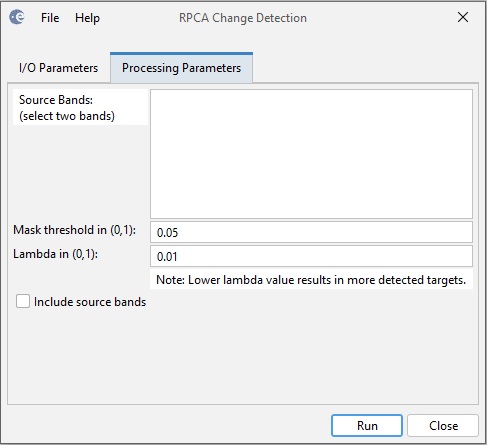
- Source Bands: All bands of the source product. User can select
two bands for change detection. If no bands are selected, then by
default all bands are used.
- Mask threshold: Threshold
used in creating the change mask. Pixel in the target band
with value that is greater than this threshold will be masked
as 1, otherwise 0.
- Lambda:
A regularization parameter that balances the background and target
terms. Lower lambda value results in more detected targets.
- Include source bands: If the checkbox is selected, all
bands of the source product will be included in the target
product together with the bands of the detected targets.
Figure 1.
RPCA Change Detection dialog box
Reference:
[1] Schwartz, C.; Ramos, L.P.; Duarte, L.T.; Pinho, M.d.S.;
Pettersson, M.I.; Vu, V.T.; Machado, R. Change Detection in UWB SAR
Images Based on Robust Principal Component Analysis. Remote Sens.
2020, 12, 1916.